
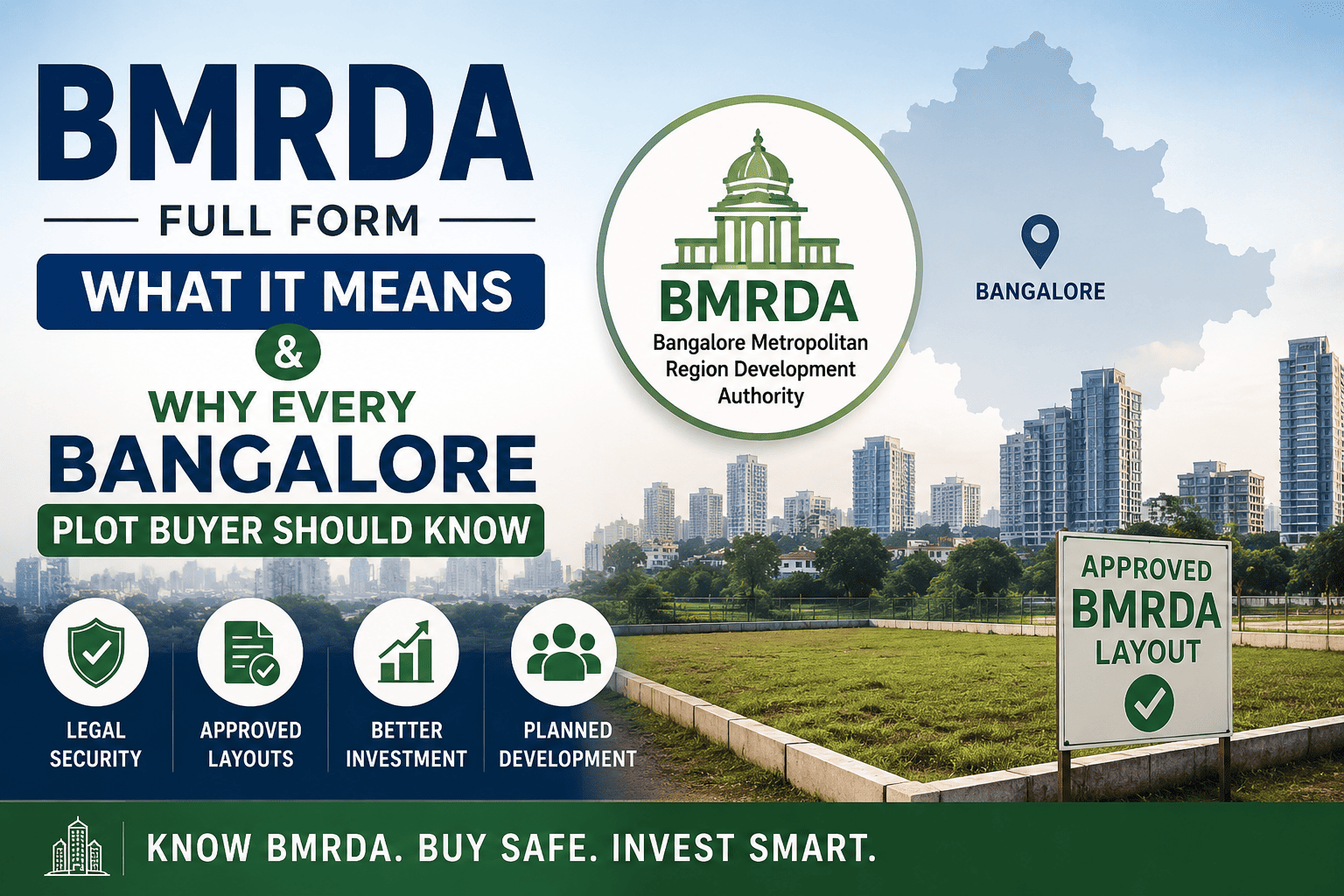
If you’ve spent any weekend driving down Mysore Road, Kanakapura Road, or navigating the dusty stretches of Hoskote looking at land, you’ve seen the term everywhere. Property boards scream it in bold letters. Agents throw it into conversation like a magic spell to close a deal. Most of us just nod along, assuming it’s a good thing, without really knowing what it promises.
Let’s break down the mystery once and for all. The BMRDA Full Form stands for the Bangalore Metropolitan Region Development Authority. Once you understand what this body actually does behind the scenes, you’ll read property listings with a completely different eye.
What Is BMRDA full form? Let’s Break it Down
To understand the true BMRDA meaning, we need to unpack the name piece by piece:
-
Bangalore Metropolitan Region: This isn’t your usual city center. It’s the massive ring of land outside the main municipal limits, spanning Bangalore Urban, Bangalore Rural, and Ramanagara districts.
-
Development Authority: A dedicated government body set up to plan, control, and structure how this massive peripheral zone grows over time.
So, what is BMRDA at its core? It’s an autonomous planning body created by the Karnataka government back in 1985 under the BMRDA Act. The goal was simple: stop the chaotic, messy urban sprawl on the edges of an exploding city. Fast forward four decades, and their job is more crucial than ever. Today, they oversee about 8,005 square kilometers of land. That makes it the second-largest metropolitan planning area anywhere in India, right behind the Amaravati region.
Where Does BMRDA Actually Have Jurisdiction?
Most buyers never bother to ask about exact boundaries, which is a massive mistake. BMRDA covers three specific districts:
-
Bangalore Urban
-
Bangalore Rural
-
Ramanagara
In real-world terms, if a piece of land sits outside the core city’s BBMP boundaries but inside this wider circle, it falls under BMRDA’s planning rules. We are talking about areas like Bidadi, Magadi, Kanakapura, Nelamangala, Hoskote, and Anekal.
Take the areas along Mysore Road, Magadi Road, and Kumbalgodu—where Gajrajah Buildcon builds layouts. They sit right in the middle of this zone. When we say our layouts are “BMRDA approved,” we aren’t just trying to sound official. It means the state’s highest metropolitan planning body has thoroughly scanned and signed off on that development.
What Does BMRDA Actually Do?
A lot of people think BMRDA just puts a rubber stamp on a piece of paper. It does a whole lot more heavy lifting than that. Here’s a look at their actual responsibilities:
-
Master Layout and Land Use Planning
They create macro plans for the entire region. These blueprints decide which land can turn into residential neighborhoods, which parts must stay green or agricultural, and what can be built where. Everything right now aligns with their Revised Structure Plan 2031.
-
Sanctioning Through Local Planning Authorities (LPAs)
BMRDA doesn’t micromanage every single plot layout from a central desk. Instead, they run eight separate Local Planning Authorities (LPAs) to handle local approvals. This includes the Anekal, Hoskote, Nelamangala, Kanakapura, and Magadi Planning Authorities, plus the Bangalore Bidadi Smart City Planning Authority.
-
Enforcing Infrastructure Standards
This is what saves you from buying into a nightmare layout. BMRDA sets hard rules for road widths, storm drains, parks, and civic amenity spaces. An approved layout must reserve roughly 50% of its total land area for public infrastructure like roads and open spaces. That’s why these gated communities look clean and organized compared to random revenue patches.
-
Building Plan Approvals
Once you buy your plot and want to start building a home, your architectural blueprint goes to BMRDA (or its local LPA branch) for legal clearance.
-
Directing Urban Policy
The Chief Minister of Karnataka chairs the BMRDA, and the Minister for Urban Development is the vice-chairman. This isn’t a small, ignored desk in a government building; it sits at the absolute top of the planning food chain.
BMRDA Approved: Meaning What That Stamp Actually Tells You
When a project is marketed as offering BMRDA approved sites, it means the developer submitted an extensive paper trail to the authorities. They checked the land conversion records, water drainage maps, open space ratios, and original title deeds before giving the project a green light.
For you as a property buyer, that approval means:
The land is officially converted from agricultural to residential or commercial use.
The wide roads, sewage lines, and parks meet minimum state standards.
The layout isn’t sitting illegally on government land, a dried lake bed, or a forest reserve.
You won’t hit a wall trying to get your building plan passed later.
Scheduled banks will actually agree to fund your site loan (banks almost always reject unapproved land).
Your future resale is safe because the title history is clean and undisputed.
If you compare this to standard revenue layouts or local gram panchayat sites, the difference is night and day. Panchayat properties operate under entirely different, much looser rules, and your long-term legal safety is never a guarantee.
BMRDA vs BDA — What’s the Difference?
If you’ve been hunting for BMRDA-approved plots, you’ve definitely run into the acronym BDA as well. It’s incredibly easy to confuse the two. Here is how they stack up side by side in the context of BMRDA Bangalore property hunting:
| Feature | BMRDA | BDA |
| Full Form | Bangalore Metropolitan Region Development Authority | Bangalore Development Authority |
| Area Covered | The growing periphery—districts outside BBMP limits | Inside the main city limits (older, central neighborhoods) |
| Land Acquisition | Does NOT acquire or seize land directly | CAN acquire land compulsorily for projects |
| Who Uses It | Private developers building layouts on the outskirts | Core residential zones managed by the city |
| Typical Locations | Mysore Road belt, Kanakapura, Hoskote, Bidadi | JP Nagar, Koramangala, Vijayanagar, Rajajinagar |
The simple rule of thumb: if you want a plot in an older, established city neighborhood, you look for BDA. If you are looking at the emerging peripheral corridors where your money buys a lot more square footage and has room to appreciate, BMRDA is the authority you need to track. Neither is “better” than the other; they just rule over completely different parts of the map.
How to Verify if a Plot Is Actually BMRDA Approved
This is the part where you need to be careful. Because the tag carries so much weight, a few shady brokers use “BMRDA approved” very loosely. Sometimes a project is merely “applied for,” or it only has a basic panchayat approval, and they’re hoping you won’t check.
Here is your step-by-step verification checklist for BMRDA-approved plots:
Step 1: Get the LP Number (Layout Plan Number)
Every single layout passed by BMRDA gets a unique LP number from the local planning authority. Ask the seller for it immediately. If they start stalling or making excuses, treat it as a massive warning sign.
Step 2: Double-Check with the Local Planning Authority Office
Take that LP number and verify it directly with the relevant office (like the Magadi or Kanakapura LPA). Make sure the plan number matches the exact layout name and developer, and check that the approval hasn’t expired.
Step 3: Look Closely at the Sanctioned Map
The officially approved layout plan map shows every single plot number, road width, and park location. Find the specific plot you want to buy on that map. If the size or location looks different from what the agent is showing you on the ground, something is wrong.
Step 4: Check the DC Conversion and Khata
Ensure the property has a clear DC Conversion Order turning the land from farming use to residential use. For a BMRDA plot, you should be looking at a proper A-Khata from the local municipality or panchayat. A B-Khata on a layout claiming full BMRDA status is an instant red flag.
Step 5: Pull a Fresh Encumbrance Certificate (EC)
Log onto the state’s Kaveri Online Services portal and pull the EC for the land. Go back at least 15 to 20 years. This will show you if the land has any hidden bank loans, court disputes, or legal liabilities tied to it.
Step 6: Hire a Lawyer to Trace the Title Chain
Don’t skip this. Spend a few thousand rupees to have an independent property lawyer trace the ownership deeds back through past owners. It’s the cheapest insurance policy you can buy when dealing with real estate.
Why BMRDA Approved Plots Are Worth the Premium
Unapproved revenue sites often look like an incredible bargain on paper. They offer lower prices per square foot, sit right across the street from approved projects, and come with smooth-talking sellers. But the hidden risks are massive.
Without a real approval, you cannot get a building plan sanctioned. That means any home you construct is technically illegal. Scheduled banks won’t touch the property for a home loan. When you try to sell years down the line, your buyer pool shrinks down to people looking to pay pure cash and take a big legal gamble. In worst-case scenarios, unapproved layouts are the first targets during government regularisation crackdowns or demolition drives.
A layout approved by the BMRDA gives you something priceless: asset security. It is fully bankable, completely legal to build on, and simple to resell. Beyond the legalities, the daily experience of living there is just better because you get engineered storm drains, wider roads, and dedicated community spaces that won’t disappear overnight.
Frequently Asked Questions About BMRDA
What is the BMRDA full form in Kannada?
It is written as ಬೆಂಗಳೂರು ಮಹಾನಗರ ಪ್ರದೇಶ ಅಭಿವೃದ್ಧಿ ಪ್ರಾಧಿಕಾರ, which directly translates back to the Bangalore Metropolitan Region Development Authority.
Is BMRDA approval the same as RERA registration?
No, they are two different things. BMRDA approval is a physical layout design and land-use sanction from the planning engineers. RERA registration is a consumer protection law focused on developer timelines, marketing transparency, and project completion. A completely safe project should have both.
Can I build a house on a BMRDA-approved plot without further approval?
No. The layout approval just means the community framework is legal. Before you start digging foundations for your specific house, you must submit your house plans to BMRDA or the local LPA to get a building plan sanction.
Does BMRDA acquire land like BDA?
No, they don’t compulsorily acquire private land to build their own layouts. Instead, they act as a regulatory umbrella that reviews and approves layouts built by private developers.
Which areas around Mysore Road fall under BMRDA?
Places like Bidadi, Kumbalgodu, Magadi Road, Ramanagara, and the surrounding developments fall under their watch. Our projects at Gajrajah Buildcon—including the Kaamdheno Residential Plots at Vadahalli—sit squarely inside these BMRDA planning zones.
What happens if I buy a plot in an unapproved layout?
You will likely face major issues getting bank financing, rejections when applying for building permits, and a difficult time finding buyers during resale. In a worst-case scenario, you could face legal notices or demolition. Always demand the LP number before paying any advance.
Closing Thoughts
The BMRDA Full Form is a lot more than dry government jargon. For anyone trying to buy a piece of land in Bangalore’s booming outer rings, knowing what BMRDA is and verifying their approval is the ultimate way to protect your hard-earned money.
The basic math is simple: if a layout has that official stamp, a real government planning body has verified its legal title and infrastructure. If it doesn’t, you are stepping into a legal minefield.
At Gajrajah Buildcon, we keep things transparent. All of our residential and industrial projects along the Mysore Road corridor are developed strictly within BMRDA-governed zones. If you want to see the original approval files, look at the LP numbers, or track the title history for any of our sites, we will happily pull out the folders and walk you through them. No high-pressure sales pitches—just clean paperwork and total clarity.